
1. Introduction
Public perception of fairness in the Criminal Justice System (CJS) is crucial for the effective and efficient maintenance of public order (Rowe, Ralph and Malik, 2024). As history has shown, when the CJS is perceived as unfair, it can lead to public disorder and create an unstable economic and political environment (Bowling, Parmar and Phillips, 2009). As perception results from social interaction (Efron, 1969), it can be distorted by the opinions of peers, the media, and other influencers (Tang et al., 2021). Concerned about the public’s susceptibility to social manipulation, this research aims to explore individuals’ experiences of interpreting CJS fairness and to identify the factors that influence this process.
The use of social media to highlight and ‘correct’ injustice became a game changer in increasing public awareness of the current state of justice (Boothe-Perry, 2014). For example, online-powered movements such as Black Lives Matter and #MeToo have “influenced legislative and judicial reforms, and sparked a broader cultural reckoning on issues of racial and gender justice” (Oluwaseyi et al., 2025). However, greater dispersion of information does not always lead to positive change and may even have the opposite effect. For instance, Pickett et al. (2015) found that the less people know about criminal punishment, the more they rely on the media to form their opinions. When social media disproportionately focuses on unjust cases, the public tends to perceive the CJS as unfair by default (Chancellor, 2019). In turn, a predominantly negative perception makes individuals more susceptible to ideas of terrorism (Marques and Paulino, 2022) and, therefore, creates opportunities for malicious actors to orchestrate public disorder (Tang et al., 2021).
Contemporary research on perceptions of CJS fairness is diverse but incomplete. Many scholars have adopted quantitative approaches to analyse the impact of predefined factors, such as the social, economic, political, and ethnic characteristics of participants and law enforcement representatives (Beier et al., 2014; Buckler, Cullen and Unnever, 2007; Socia et al., 2021). In contrast, qualitative studies have primarily explored this phenomenon from the perspectives of the accused and victims, but not those of ordinary citizens (Alda et al., 2020; Augustyn, 2016; Hester et al., 2025). Overall, there remains a lack of understanding of what the public base their perceptions of CJS fairness on. If such perceptions result predominantly from popular opinion rather than facts and evidence, society may become more susceptible to misinformation and manipulation leading to public disorder.
Hence, this study aims to explore what people rely on when shaping their perceptions of CJS fairness. First, this paper will outline the process of data collection and analysis. It will explain the choice of Interpretative Phenomenological Analysis (IPA; Smith and Eatough, 2007) and how it was applied to answer the research question. Next, it will report the results of the analysis through the identified superordinate themes. Finally, this study will discuss the findings and link them to the existing academic literature. In doing so, it will propose an ‘influence framework’ to explain the explored phenomenon. The discussion will conclude with an acknowledgement of the study’s implications, limitations, and potential for further research.
2. Method
2.1. Design
The research is designed as a multiple-case study employing IPA, with data collected via semi-structured interviews. This design was chosen due to the dynamic nature of perception (Augustyn, 2016). In this context, the application of quantitative research methods was considered unsuitable because of their tendency to produce a static view (Clark et al., 2021). Additionally, the study aimed to explore individuals’ experiences of interpreting CJS fairness and to identify the factors that influence this process. Therefore, a qualitative approach employing IPA was considered a better fit.
2.2. Participants
The participants were selected through a combination of purposive and convenience sampling. Three selection criteria were applied: full-time employment, Irish citizenship, and the absence of direct experience with the CJS. The final sample consisted of two participants from the same household, of different genders, aged 35-36 years. To ensure anonymity, the pseudonyms ‘Alex’ and ‘Jo’ were employed.
2.3. Procedure
An invitation to participate in the study was made in person. Once accepted, each participant received an ethics form (see Appendix A) by email. Each interview was scheduled for 20-30 minutes, in a quiet place of the participant’s choice. It began with a briefing on the research and the participants’ rights. The researcher re-emphasised that the interview would be recorded and quoted. After obtaining written consent (see Appendix B), the researcher proceeded with data collection. The interview schedule included the following questions: What is a fair CJS? What are the examples of Irish CJS (un)fairness? What are the sources of these examples? How susceptible is the CJS to public opinion? What would the participants change to improve or maintain the fairness of the CJS? Finally, the participants were given an opportunity to add any other information they considered important. The conversations were recorded and automatically transcribed using the iOS Voice Memos application. After the recording was stopped, each meeting concluded with a debriefing on the value of participation, data handling, and contacts for questions or support.
2.4. Ethics
The research was conducted in accordance with the research ethics guidelines of the British Psychological Society (2021) and the British Society of Criminology (2015). The research topic, interview questions, and participant information sheet were reviewed and approved by an authorised scholar. Additionally, the author of this study noted a potential risk of evoking troubling memories or stimulating a significant emotional response to perceived injustices. Therefore, the participants were reminded that they could stop the interview at any time and refuse to answer any question. The information on accessing support agencies was also provided. To ensure confidentiality, the data were stored in a secure cloud environment with access limited to the researcher only. The recordings were deleted after the anonymised transcripts of sufficient quality were produced.
2.5. Analysis
The data were analysed in three phases: (a) the autogenerated transcription of the first interview was corrected to ensure accuracy and truthfulness, and IPA was applied; (b) the process was repeated with the second interview; and (c) the defined themes were combined into the final set (Pietkiewicz and Smith, 2014). To define the themes in each of the interviews, the following criteria were used: (a) relevance to the research question, in combination with either (b) frequent occurrence or (c) strong emphasis. The validity of the themes was tested against quotes from the transcripts. The emergent themes that received insufficient support were eliminated. The remaining themes were organised into a table for each interview separately. They were then iteratively revised, aligned, and then combined into the final table of themes. For this, the themes from the interview with Jo were used as a baseline, as they better answered the research question. After each iteration, the revised themes were re-validated against supporting quotes. The outcomes of each phase are listed in Appendix C. The findings were also shared with the participants to ensure the trustworthiness of the study. However, only Jo approved the results and conclusions. Alex did not provide feedback. Finally, both participants gave their consent via email for this study and its anonymised supplementary materials to be published.
3. Results
The IPA produced three superordinate themes: the actions of the CJS, biases and opinions, and personal values (see Table 1).
Table 1 Themes
| Superordinate theme | Sub-themes |
|---|---|
| The actions of the CJS |
|
| Biases and opinions |
|
| Personal values |
|
3.1. The actions of the CJS
This theme was derived from what are termed ‘shining gems’ – easily recognisable, dominant utterances with clear meaning (Eatough and Smith, 2017). For Alex, victims’ efforts to obtain justice had the greatest impact on their perception of CJS fairness. The impression that victims “need to fight a lot more to get justice than they should have to” conflicts with the participant’s understanding of the CJS’s purpose – “getting justice for people who have been wronged” – thereby portraying the CJS as unfair. Additionally, Alex compared punishment within the Irish system to a joke:
[Y]ou can murder someone in Ireland and be out ... in half the time … [W]e hear people saying stuff like, “You get less time for murder.” … And, unfortunately, like it’s a true fact. It’s a joke, but at the same time, … it’s legitimate.
While the default conviction for murder in Ireland is life imprisonment, Alex’s comment relates to sentence mitigation and the right to parole, which they view as insufficient justice.
Similarly, Jo emphasised that offenders are given “too many chances”, which, in turn, normalises unacceptable behaviour: “I think oftentimes the message that sends out [sic] to the community is that it’s okay, when it’s absolutely not okay.” As a result, those who are given additional chances often fall into a cycle of reoffending, while those who have not yet offended may be just as likely to do so. In other words, Jo perceives such leniency in the Irish CJS as an enabler of reoffending rather than as restorative justice in practice.
3.2. Biases and opinions
The next theme examines the impact of biases and opinions on the formation of perceptions. The influence of bias on perception appears to be complex, intertwining social status bias, media representation bias, and personal bias. Both participants believe that the CJS’s unfairness results from social status bias. Alex summarised this as: “it’s like some people … deserve a second chance, but others don’t because of their background.” Similarly, Jo elaborated:
I do think if you have a type of … profile in sport or … if you’re a known person, … you can be treated with lenience. But … because I’m just ordinary Jo, … I’m not going to be treated with the same approach.
As most court cases reported in the media involve high-profile individuals, both participants referred to them to exemplify bias in the CJS. Therefore, this perception is likely the result of the selective representation of court rulings. At the same time, Alex’s comment on another occasion – “Everyone knows what he’s like, so I don’t like him. So, my first opinion was … ‘He’s wrong’” – suggests a projection of their own bias onto CJS decision-making.
Further, while acknowledging the impact of authoritative statements, both participants were somewhat sceptical about their relevance and use in court. For example, Jo perceives the value of ‘good character’ evidence as conditional:
I have ... to hope that the jury and the judge and the criminal justice system can see that I’m a good person. So maybe I get ... my boss in to talk about how good I am. But if I have 64 previous convictions, those people coming in saying I’m a nice [person], it shouldn’t matter so much.
Meanwhile, Alex highlighted a dilemma in accepting ‘good character’ verbal evidence:
So that may be [from the] pressure of the other people of higher ranking … saying that this is a good person. So, I should think that they’re a good person, and would I be judged as a judge for sentencing this person?
This comment, however, reflects a deeper experience of shaping perception, beyond mere reliance on credible opinions. It reveals that, while Alex tends to question the legitimacy of such evidence, they are also concerned about being criticised for dismissing it. In other words, when forming their own opinion, Alex considers whether it will be socially acceptable. Consequently, it is unsurprising that Alex acknowledged the greater influence of social media on their judgement compared with other media sources.
In contrast, Jo, who refuses to use social media, firmly stated that “the court of public opinion shouldn’t have the right to influence your trial.” Nevertheless, they did not deny its effect on the CJS:
I don’t know if public opinion would sway it in judge [sic] giving a sentence. But had public opinion … not gotten behind Natasha’s case, I don’t think the DPP [Director of Public Prosecutions] would have challenged the verdict.
Unlike Alex, throughout the interview, Jo demonstrated a strong preference for forming their own independent opinion, rarely referring to other sources. Such behaviour indicates a critical approach and resilience to unverified mainstream perceptions. Instead, the participant evaluates information through a set of personal values, which is discussed next.
3.3. Personal values
The last identified influential factor was the participants’ values. For Alex, being correctly informed is essential for making judgements: “[I]f people want to research, they probably should be researching facts. I mean, the actual facts of a case, the scripts in cases.” In this way, Alex counterbalances their susceptibility to public opinion with more objective sources of information.
While Alex strives to make informed decisions, Jo believes that their pro-victim attitude influences their perception of CJS fairness:
I think I am the type of person who can relate to an underdog, … to a weaker person. … I would always be the type of person who would have sympathy with the victim.
Interestingly, this comment contradicts the balanced arguments and examples that Jo used during the interview. For example:
[A]nybody can make a mistake. And that’s why you have to be careful when you talk about harsher sentences. It’s about harsher sentences in the appropriate situation.
This contradiction, however, is not the result of internal conflict. Instead, it indicates that this participant perceives CJS fairness through the lens of humanity. For them, it is important to account for the circumstances of the offending when making judgements. Furthermore, on several occasions throughout the interview, Jo referred to the importance of being “a good character.” In other words, fair justice should consider the kind of person the offender is. This does not mean that people should receive a lenient sentence simply because they are perceived as ‘good’ by witnesses or according to the offender’s profile. Such an interpretation would not align with the participant’s sceptical opinion about this kind of evidence (see 3.2. Biases and opinions). Instead, for Jo, an indication of good character is one’s ability to acknowledge mistakes and accept punishment. Conclusively, fair justice is the wise one: strict but understanding.
It is also important to note that whenever personal values emerged during the conversations, both Alex and Jo were very firm and used a convincing tone to make their points. Such emotional investment suggests that this factor has the strongest and deepest impact on their decision-making. It also plays a safeguarding role for their independent thinking: personal values actively shape how information is processed and perceived, rather than passively adjusting to the opinions of others.
Finally, both participants recognised the complexity of justice. At the end of the interview, Jo concluded:
It can’t be an easy position to be … a judge or … the Minister for Justice … [b]ecause … they have to be able to tell the difference between somebody who’s made a mistake and somebody who’s just in and out and a bad person. And sometimes that line can be a bit hard to identify.
Such an acknowledgement demonstrates an understanding that there is much more to CJS fairness than one’s personal opinion. In turn, this critical thinking reduces the participants’ susceptibility to radicalisation.
4. Discussion
Concerned about the public’s susceptibility to malicious manipulation, this research aimed to understand individuals’ experiences of perceiving CJS fairness. For this purpose, IPA was applied to data from two semi-structured interviews with Irish citizens. The results revealed three superordinate themes: the actions of the CJS, biases and opinions, and personal values. The influence of social media on perception was indeed mentioned by the participants under the second theme. However, this factor did not appear to be predominant in shaping opinions and was counterbalanced by the participants’ critical thinking. Moreover, the findings revealed that themes outlined in this study are not isolated from one another. In other words, the CJS fairness perception is a result of synergy between different influenceable factors. To understand this phenomenon better, it is worth exploring an ‘influence framework’ presented with Figure 1.
Figure 1 Influence framework
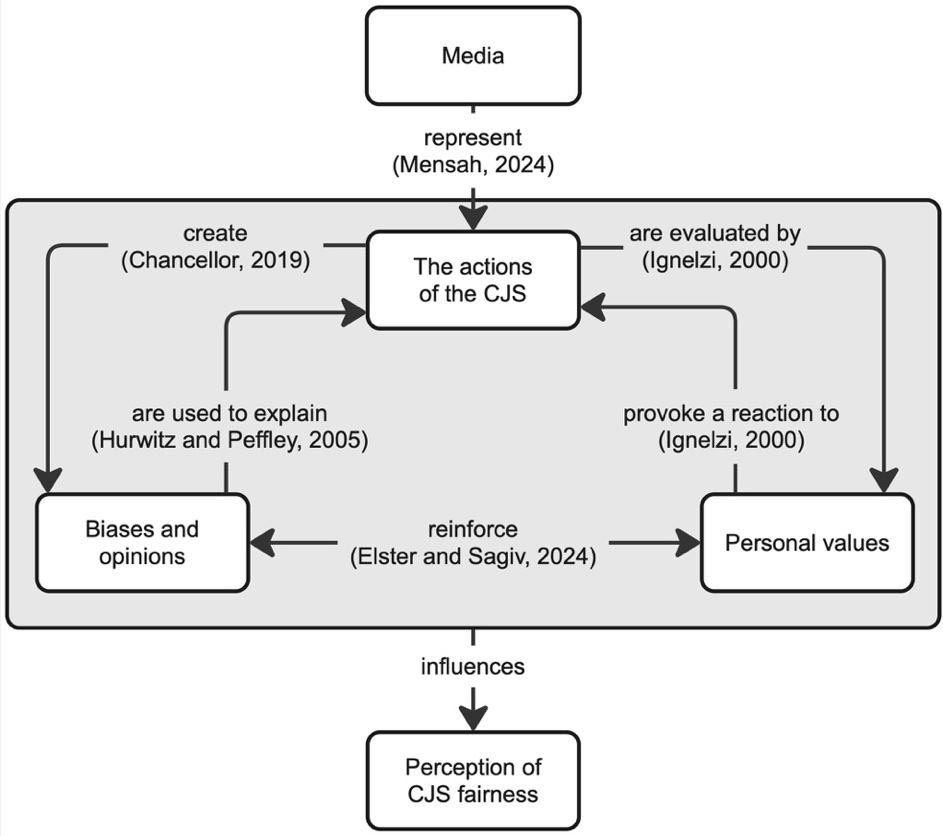
In a nutshell, following the principles of hermeneutics and phenomenology, one must experience or observe the CJS acting (un)fairly to make an opinion of its fairness (Smith, Flowers and Larkin, 2022). As most people do not directly encounter the CJS, this experience normally is obtained from criminal cases represented by the media (Mensah, 2024). On one hand, as the media representation is selective, it creates a tendency to perceive CJS’s actions from either positive or negative, but less often neutral, perspective (Chancellor, 2019). In turn, the public interprets what they are shown through their own confirmation bias (Hurwitz and Peffley, 2005). On the other hand, individuals also evaluate presented actions using their personal values (Ignelzi, 2000). A result is a perception of fairness that further is expressed as a reaction to the events (Ignelzi, 2000). In the current context, the event is a particular CJS’s action at a given point in time, and the individual’s reaction to it depends on how well it aligns with their personal values. Eventually, the system closes in a loop through mutual reinforcement between personal values and bias. When there is concordance between them, the established perception gains ‘double support’ (Elster and Sagiv, 2024).
The discussed synergy of influential factors has implications for policymaking. For example, a greater focus on representing the ‘fair’ side of the CJS may lead to a shift in public opinion. Similarly, investment in the development of pro-just personal values can reframe what people understand as fair justice. However, this does not necessarily result in a better or more accurate perception of the CJS. For instance, if the way the CJS is portrayed in the media contradicts the ‘court of public opinion’, the media itself may be perceived as biased or corrupted. Likewise, improved public education on law and human rights does not guarantee that this knowledge will not be filtered through confirmation bias or that it will not intensify the impact of public opinion. Therefore, policies should account for possible side effects and address all components of the ‘influence framework’ collectively, rather than regulating each factor separately.
It is also worth noting the study’s limitations. First, the study design does not allow for generalisation. Second, this research explored the perception of the Irish CJS. Therefore, the results obtained in other countries may vary depending on the structure, functioning, and representation of the local CJS. Similarly, differences in cultural and political environments may influence the level of susceptibility to different sources of information. The social class of the participants also limits the findings to Irish middle-class citizens. The perceptions of immigrants, as well as those of residents from other social classes, may therefore differ. In summary, as the design suggests, this study aimed to explore CJS fairness perception in depth, without claiming external validity. It was also conducted to encourage further research, including: (a) investigating other factors and their synergy to obtain a full picture; (b) examining the strength of the relationships between the identified factors; and (c) assessing the impact of household members on each other’s opinions, especially in contexts where domestic abuse is present.
References
Alda, E. et al. (2020) ‘Antecedents of Perceived Fairness in Criminal Courts: A Comparative Analysis’, International Journal of Comparative and Applied Criminal Justice, 44(3), pp. 201-219. Available at: https://doi.org/10.1080/01924036.2019.1615521
Augustyn, M. B. (2016) ‘Updating Perceptions of (In)Justice’, Journal of Research in Crime and Delinquency, 53(2), pp. 255-286. Available at: https://doi.org/10.1177/0022427815616991
Beier, S. et al. (2014) ‘Influence of judges’ behaviors on perceived procedural justice’, Journal of Applied Social Psychology, 44(1), pp. 46-59. Available at: https://doi.org/10.1111/jasp.12199
Boothe-Perry, N. A. (2014) ‘Friends of justice: does social media impact the public perception of the justice system’, Pace Law Review, 35(1), pp. 72-114. Available at: https://heinonline.org/HOL/Page?collection=journals&handle=hein.journals/pace35&id=76&men_tab=srchresults (Accessed: 16 December 2025).
Bowling, B., Parmar, A. and Phillips, C. (2009) ‘Policing minority ethnic communities’, in T. Newburn (ed) Handbook of policing. 2nd edn. London: Willan, pp. 611-641.
British Psychological Society. (2021) BPS Code of Human Research Ethics. Available at: https://www.bps.org.uk/guideline/bps-code-human-research-ethics (Accessed: 12 July 2025).
British Society of Criminology. (2015) Statement of Ethics for Researchers in the Field of Criminology. Available at: https://www.britsoccrim.org/ethics/ (Accessed: 12 July 2025).
Buckler, K., Cullen, F. T. and Unnever, J. D. (2007) ‘Citizen assessment of local criminal courts: Does fairness matter?’, Journal of Criminal Justice, 35(5), pp. 524-536. Available at: https://doi.org/10.1016/j.jcrimjus.2007.07.005
Chancellor, L. (2019) ‘Public contempt and compassion: media biases and their effect on juror impartiality and wrongful convictions’, Manitoba Law Journal, 42(3), pp. 427-444. Available at: https://heinonline.org/hol-cgi-bin/get_pdf.cgi?handle=hein.journals/manitob42§ion=40 (Accessed: 5 July 2025).
Clark, T. et al. (2021) Bryman’s Social Research Methods. 6th ed. Oxford: Oxford University Press.
Eatough, V. and Smith, J. A. (2017) ‘Interpretative Phenomenological Analysis’, in C. Willig and W. Stainton-Rogers (eds) The SAGE Handbook of Qualitative Research in Psychology. 2nd edn. London: SAGE Publications, pp. 193-211. Available at: https://doi.org/10.4135/9781526405555.n12
Efron, R. (1969) ‘What is Perception?’, in R. S. Cohen and M. W. Wartofsky (eds) Proceedings of the Boston Colloquium for the Philosophy of Science 1966/1968. Boston Studies in the Philosophy of Science. 4. Dordrecht: Springer, pp. 137–173. Available at: https://doi.org/10.1007/978-94-010-3378-7_4
Elster, A. and Sagiv, L. (2024) ‘Personal Values and Cognitive Biases’, Journal of Personality, Early View. Available at: https://doi.org/10.1111/jopy.13001
Hester, M. et al. (2025) ‘What Is Justice? Perspectives of Victims-Survivors of Gender-Based Violence’, Violence Against Women, 31(2), pp. 570-597. Available at: https://doi.org/10.1177/10778012231214772
Hurwitz, J. and Peffley, M. (2005) ‘Explaining the Great Racial Divide: Perceptions of Fairness in the U.S. Criminal Justice System’, The Journal of Politics, 67(3), pp. 762-783. Available at: https://doi.org/10.1111/j.1468-2508.2005.00338.x
Ignelzi, M. (2000) ‘Meaning-Making in the Learning and Teaching Process’, New Directions for Teaching & Learning, 2000(82), pp. 5-14. Available at: https://pressbooks.uiowa.edu/app/uploads/sites/215/2021/06/Ignelzi-Meaning-Making.pdf (Accessed: 5 July 2025).
Marques, P. B. and Paulino, M. (2022) ‘Conclusion Police psychology and contemporary challenges in an uncertain world’, in P. B. Marques (ed) Police Psychology: New Trends in Forensic Psychological Science. Academic Press, pp. 395-405. Available at: https://doi.org/10.1016/b978-0-12-816544-7.15001-6
Mensah, E. K. G. (2024) Assessing the Role of Media Influence and Public Perception in Legal Decision-Making. Available at: http://dx.doi.org/10.2139/ssrn.4811277
Oluwaseyi, J. et al. (2025) Social Justice Movements: The Role of Movements Like Black Lives Matter and MeToo in Shaping Politics and Society. Available at: https://www.researchgate.net/publication/391279166 (Accessed: 16 December 2025).
Pickett, J. T. et al. (2015) ‘Public (Mis)Understanding of Crime Policy: The Effects of Criminal Justice Experience and Media Reliance’, Criminal Justice Policy Review, 26(5), pp. 500-522. Available at: https://doi.org/10.1177/0887403414526228
Pietkiewicz, I. and Smith, J. A. (2014) ‘A Practical Guide to Using Interpretative Phenomenological Analysis in Qualitative Research Psychology’, Psychological Journal, 20(1), pp. 7-14. Available at: https://doi.org/10.14691/CPPJ.20.1.7
Rowe, M., Ralph, L. and Malik, A. (2024) Introduction to Policing. 4th edn. California: Sage.
Smith, J. A. and Eatough, V. (2007) ‘Interpretative phenomenological analysis’, in E. Lyons and A. Coyle (eds) Interpretative phenomenological analysis. London: SAGE Publications, pp. 35-50. Available at: https://doi.org/10.4135/9781446207536.d10
Smith, J. A., Flowers, P. and Larkin, M. (2022) Interpretative Phenomenological Analysis. 2nd edn. London: Sage Publications.
Socia, K. M. et al. (2021) ‘Public Perceptions of Police Agency Fairness and the Willingness to Call Police’, The American Review of Public Administration, 51(5), pp. 360-373. Available at: https://doi.org/10.1177/02750740211005699
Tang, W. et al. (2021) ‘Susceptible user search for defending opinion manipulation’, Future Generation Computer Systems, 115, pp. 531-541. Available at: https://doi.org/10.1016/j.future.2020.10.003
Copyright Statement
© Antonina Savka. This article is licensed under a Creative Commons Attribution 4.0 International Licence (CC BY).